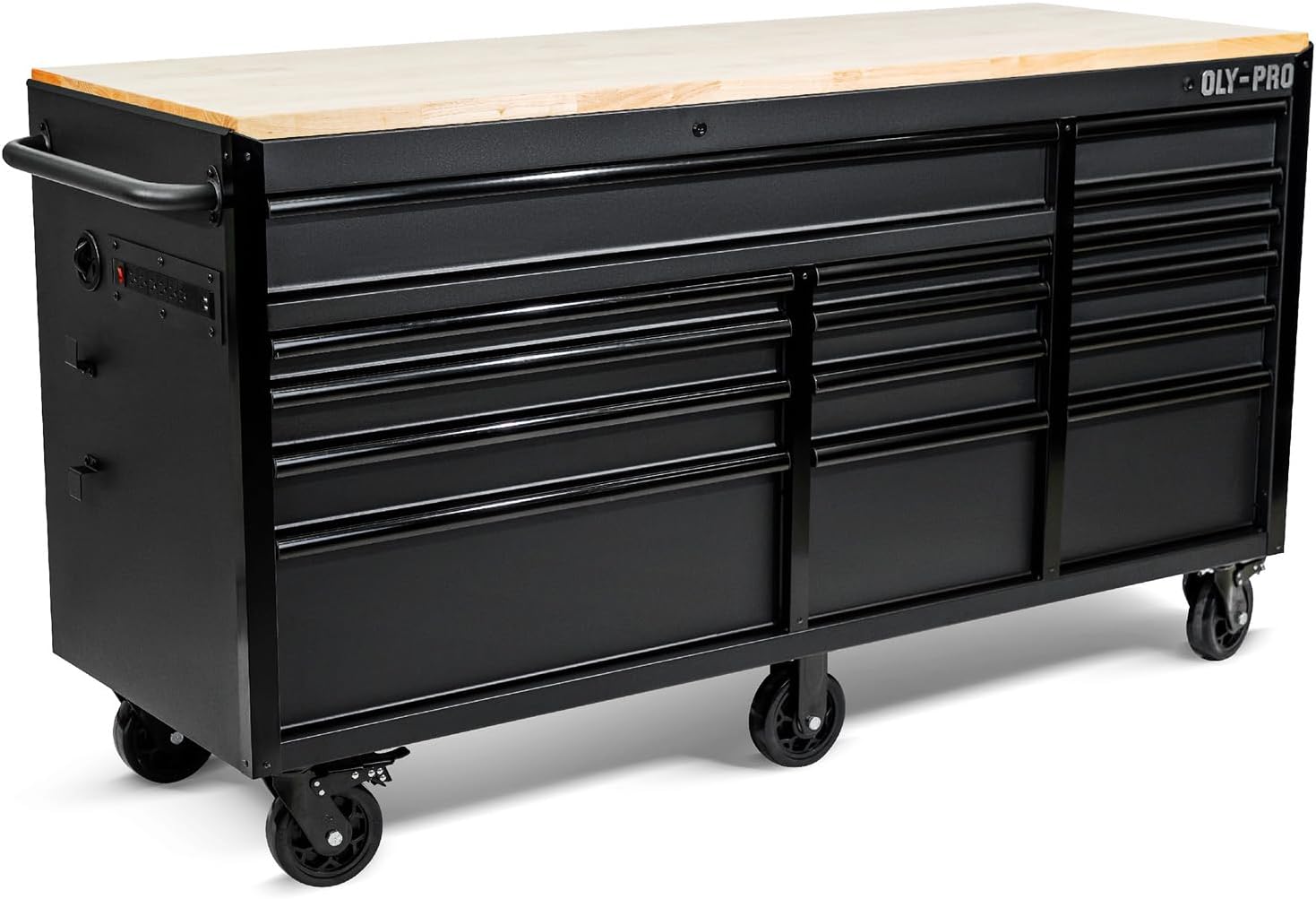
Husky tool box weight capacity tells you how much weight the entire cabinet, individual drawers, drawer slides, and caster wheels can safely support. Standard Duty Husky boxes are usually best for light tools, Heavy Duty models are better for mechanics and large tool collections, and Professional Duty models are designed for the heaviest garage and workshop use.
If you own heavy socket sets, impact tools, air tools, pullers, hammers, or large power tools, weight capacity should be one of the first specs you check before buying a Husky tool box.
What Does Husky Tool Box Weight Capacity Mean?
Husky tool box weight capacity refers to the maximum amount of weight a tool box can safely hold. This includes the weight supported by the cabinet frame, drawers, drawer slides, top work surface, and caster wheels.
Many people only look at the total capacity number, but that is not enough. You also need to understand how much weight each drawer can hold and how the weight should be distributed inside the cabinet.
For example, a tool chest may have a high total capacity, but each drawer still has its own drawer slide rating. If you overload one drawer with heavy sockets or metal tools, the drawer may sag, stick, or damage the slide system.
The 4 Types of Weight Capacity You Need to Understand
There are four important weight ratings to check before buying or loading a Husky tool box.
| Capacity Type | What It Means | Why It Matters |
|---|---|---|
| Total cabinet capacity | Total weight the full tool box can support | Helps you understand the overall strength of the cabinet |
| Drawer slide capacity | Weight each drawer can safely hold | Prevents drawer sagging, sticking, or slide damage |
| Caster capacity | Weight the wheels can support while moving or parked | Important for rolling tool boxes and mobile workbenches |
| Worktop capacity | Weight the top surface can support | Important if using the box as a workbench |
For most users, drawer slide capacity and caster capacity are just as important as total cabinet capacity.
Total Cabinet Capacity
Total cabinet capacity is the maximum weight the whole Husky tool box can support. This includes tools stored in all drawers, tools placed on top, and any accessories added to the box.
A higher total capacity is useful if you store:
- Full socket sets
- Ratchets
- Wrenches
- Hammers
- Pry bars
- Pullers
- Impact tools
- Air tools
- Power tools
- Batteries and chargers
- Automotive repair tools
If your tool collection is light, you may not need the highest capacity model. But if your tool collection is growing, buying a stronger cabinet can prevent future problems.
Drawer Slide Capacity
Drawer slide capacity tells you how much weight each drawer can safely hold. This is one of the most important specs on a Husky tool box.
Many Husky rolling cabinets and mobile workbenches use ball-bearing drawer slides. Some models include soft-close slides, and some deeper drawers may use double slides for extra support.
Drawer slide ratings may vary by model. Some Husky Standard Duty drawers may support around 100 lbs per drawer, while many Heavy Duty models use 120-lb rated soft-close ball-bearing slides. Some Professional Duty models may include 220-lb rated soft-close drawer slides.
A higher drawer slide rating is helpful for heavy tools such as:
- Large socket sets
- Impact sockets
- Wrench sets
- Pullers
- Hammers
- Air tools
- Metal accessories
- Automotive tools
If a drawer feels hard to open, does not close properly, or starts to sag, it may be overloaded or the drawer slide may be damaged.
Caster Capacity on Rolling Husky Tool Boxes
Caster capacity is very important for Husky rolling tool boxes and mobile workbenches. Casters are the wheels under the cabinet. They support the loaded box and allow it to move around the garage or workshop.
A tool box may have a strong steel cabinet, but if the casters are weak, the box can become difficult or unsafe to move.
Good casters should provide:
- Strong load support
- Smooth movement
- Wheel locks
- Stable parking
- Better movement on concrete floors
- Resistance to wobbling
Heavy Duty Husky rolling tool boxes often include larger casters than smaller Standard Duty units. Larger casters usually roll better over rough garage floors, small cracks, dust, and uneven surfaces.
Always lock the casters after placing the tool box in its final position.
Worktop Capacity
Some Husky tool boxes guide are mobile workbenches with a wood top, stainless steel top, or solid work surface. Worktop capacity refers to how much weight the top surface can support.
This matters if you use the top for:
- Small repairs
- Tool layout
- Battery charging
- Assembly work
- Cleaning parts
- Holding power tools
- Light mechanical work
Do not use the top surface as a heavy-duty hammering table unless the product is designed for that type of work. Too much force or weight on the top may damage the work surface or cabinet frame.
Standard Duty vs Heavy Duty vs Professional Duty Capacity
Husky tool boxes are often grouped into Standard Duty, Heavy Duty, and Professional Duty categories. These categories help you understand the expected strength level.
Standard Duty Husky Tool Boxes
Standard Duty Husky tool boxes are best for homeowners, light DIY users, and basic garage storage.
Best for:
- Screwdrivers
- Pliers
- Small socket sets
- Household tools
- Light power tools
- Tape measures
- Utility knives
- Basic repair tools
Standard Duty models are usually more affordable and lighter than Heavy Duty models. They are a good option if you do not plan to store many heavy tools.
Heavy Duty Husky Tool Boxes
Heavy Duty Husky tool boxes are better for serious DIY users, home mechanics, and larger tool collections.
Best for:
- Heavy socket sets
- Ratchet sets
- Impact tools
- Air tools
- Automotive tools
- Drill and battery storage
- Large wrench sets
- Garage workshop setups
Heavy Duty models usually offer stronger drawer slides, better steel construction, and higher total capacity than Standard Duty options.
Professional Duty Husky Tool Boxes
Professional Duty Husky tool boxes are designed for heavy daily use and large tool collections.
Best for:
- Professional mechanics
- Commercial garages
- Heavy automotive tools
- Frequent drawer use
- Large shop setups
- High-capacity storage
Professional Duty models are usually the strongest Husky options. These are best when you need maximum capacity, thicker steel, stronger drawer slides, and heavy-duty caster support.
Husky Tool Box Capacity Comparison
| Husky Category | Best For | Typical Tool Load | Recommended User |
| Standard Duty | Light tools and home use | Basic hand tools and small power tools | Homeowners and beginners |
| Heavy Duty | Heavy garage tools | Sockets, wrenches, drills, air tools | DIY users and home mechanics |
| Professional Duty | Very heavy daily use | Large mechanic tools and shop equipment | Professionals and large garages |
The right choice depends on your tool weight, not just the number of drawers.
How Much Weight Can a Husky Tool Box Hold?
The exact weight capacity depends on the specific Husky model. Smaller rolling cabinets usually have lower total capacity, while larger Heavy Duty and Professional Duty models support much more weight.
As a general buying rule:
- Choose Standard Duty for light household tools.
- Choose Heavy Duty for heavy garage and mechanic tools.
- Choose Professional Duty for the largest and heaviest tool collections.
Always check the model’s product specifications before buying because two Husky tool boxes with the same width may have different drawer slide ratings, steel gauge, and total capacity.
What Happens If You Overload a Husky Tool Box?
Overloading a Husky tool box can cause several problems.
Common issues include:
- Drawers become hard to open
- Drawer slides bend or fail
- Drawers do not close smoothly
- The cabinet becomes unstable
- Casters become difficult to roll
- Wheels may wear out faster
- The frame may flex
- Tools may shift inside drawers
- The box may become unsafe to move
The biggest risk is overloading one drawer or one side of the cabinet. This can make the tool box uneven and harder to control.
Best Drawer Layout for Heavy Tools
A smart drawer layout protects the box and makes your tools easier to find.
Top Drawers
Use top drawers for lighter, frequently used tools:
- Screwdrivers
- Pliers
- Ratchets
- Tape measure
- Utility knife
- Hex keys
- Small sockets
- Small parts trays
Middle Drawers
Use middle drawers for medium-weight tools:
- Wrenches
- Ratchet sets
- Electrical tools
- Specialty tools
- Drill bits
- Driver bits
- Small hand tools
Bottom Drawers
Use bottom drawers for the heaviest tools:
- Impact tools
- Power tools
- Batteries
- Chargers
- Large sockets
- Hammers
- Pry bars
- Pullers
- Grinders
Keeping heavy tools in the bottom drawers improves stability and reduces stress on upper drawers.
How to Avoid Overloading Your Husky Tool Box
Follow these simple tips to protect your tool box:
- Check the total weight capacity before buying.
- Check the drawer slide rating before loading each drawer.
- Put heavy tools in bottom drawers.
- Spread weight evenly from left to right.
- Do not store all heavy sockets in one small drawer.
- Use drawer liners to reduce tool movement.
- Keep the box on a flat, level surface.
- Lock casters after moving the box.
- Do not move the tool box with drawers open.
- Avoid using the top as a heavy-impact workbench.
These steps help prevent drawer damage, caster stress, and cabinet instability.
Signs Your Tool Box Drawer Is Overloaded
A drawer may be overloaded if:
- It feels heavy to pull open
- It does not close fully
- It sags when extended
- It makes grinding noises
- The drawer front looks uneven
- The slides feel rough
- The drawer opens by itself
- The cabinet leans when the drawer is open
If you notice these signs, remove some weight and inspect the drawer slides.
Weight Capacity for Socket Sets and Mechanic Tools
Sockets are small, but they are dense and heavy. A full drawer of sockets can weigh much more than expected.
For socket storage:
- Use socket rails
- Spread sockets across multiple drawers
- Keep large impact sockets in lower drawers
- Avoid placing all sockets in one shallow drawer
- Use drawer liners or foam inserts
Mechanic tools should be organized by both category and weight. This makes the cabinet safer and easier to use.
Weight Capacity for Power Tools
Power tools are bulky and can be heavy, especially when stored with batteries and chargers.
Store these tools in deep lower drawers:
- Drills
- Impact drivers
- Impact wrenches
- Grinders
- Sanders
- Battery packs
- Chargers
- Air tools
Do not overload one deep drawer with every power tool you own. Spread the weight across the cabinet when possible.
Can You Move a Fully Loaded Husky Tool Box?
You can move some loaded Husky rolling tool boxes, but you should do it carefully. Large loaded tool boxes can be extremely heavy.
Before moving the box:
- Close every drawer
- Lock the drawers if possible
- Remove items from the top
- Unlock the casters
- Push slowly
- Avoid slopes
- Avoid rough floors
- Ask for help with large cabinets
Never move a loaded tool box with open drawers. This can cause tipping or damage.
Best Husky Tool Box for Heavy Tools
For heavy tool collections, choose a Husky Heavy Duty or Professional Duty tool box. These models are better suited for sockets, mechanic tools, power tools, air tools, and daily garage use.
Look for:
- Higher total capacity
- Strong drawer slides
- Ball-bearing slides
- Soft-close drawers
- Strong casters
- Thicker steel
- Deep bottom drawers
- Lockable drawers
- Wide cabinet frame
A 52-inch Heavy Duty model is often enough for home mechanics. A 72-inch Professional Duty model is better for large garages or professional shops.
Common Mistakes Buyers Make
Avoid these mistakes when choosing a Husky tool box:
- Buying based only on width
- Ignoring drawer slide ratings
- Ignoring caster strength
- Choosing Standard Duty for heavy mechanic tools
- Overloading small top drawers
- Forgetting to measure garage space
- Not checking product specifications
- Putting all heavy tools on one side
- Moving the box too quickly when loaded
- Not using drawer liners
A tool box should be selected based on tool weight, drawer use, and workspace needs—not just price.
Final Recommendation
If your tool collection is light, a Standard Duty Husky tool box is usually enough. If you own heavy sockets, impact tools, air tools, or mechanic equipment, choose a Heavy Duty Husky tool box. If you need maximum strength for daily shop use, choose a Professional Duty Husky tool chest.
For most homeowners and home mechanics, a Heavy Duty Husky rolling tool box gives the best balance of capacity, strength, and value.
Always check the total cabinet capacity, drawer slide rating, caster strength, and steel construction before buying.
FAQs About Husky Tool Box Weight Capacity
What does Husky tool box weight capacity mean?
Husky tool box weight capacity means the amount of weight the cabinet, drawers, slides, casters, and worktop can safely support. You should check both total capacity and drawer capacity before loading heavy tools.
How much weight can a Husky tool box drawer hold?
It depends on the model. Some Standard Duty drawers may support around 100 lbs, many Heavy Duty models use 120-lb rated drawer slides, and some Professional Duty models may support up to 220 lbs per drawer.
Can I put heavy sockets in a Husky tool box?
Yes, but heavy sockets should be spread across drawers instead of placed all in one drawer. Large impact sockets and heavy socket sets are best stored in lower drawers.
What is the best Husky tool box for heavy tools?
A Heavy Duty or Professional Duty Husky tool box is best for heavy tools. These models usually have stronger drawer slides, higher total capacity, better casters, and thicker steel construction.
Can you overload a Husky tool box?
Yes. Overloading can damage drawer slides, stress the casters, make drawers difficult to close, and make the cabinet unstable. Always follow the model’s weight capacity limits.
Should heavy tools go in the top or bottom drawers?
Heavy tools should go in the bottom drawers. This improves stability and reduces the risk of tipping when drawers are open.
Does caster capacity matter?
Yes. Caster capacity is very important on rolling tool boxes. Weak or overloaded casters can make the box hard to move and may create safety issues.
Are Husky Heavy Duty tool boxes better than Standard Duty?
Heavy Duty Husky tool boxes are better for heavier tools, larger tool collections, and frequent use. Standard Duty models are better for light home tools and basic garage storage.
What happens if a drawer slide is overloaded?
An overloaded drawer slide may sag, bend, stick, or fail. The drawer may become hard to open or may not close correctly.
Do drawer liners help with weight capacity?
Drawer liners do not increase the official weight capacity, but they help keep tools from sliding around. This protects the drawer surface and improves organization.