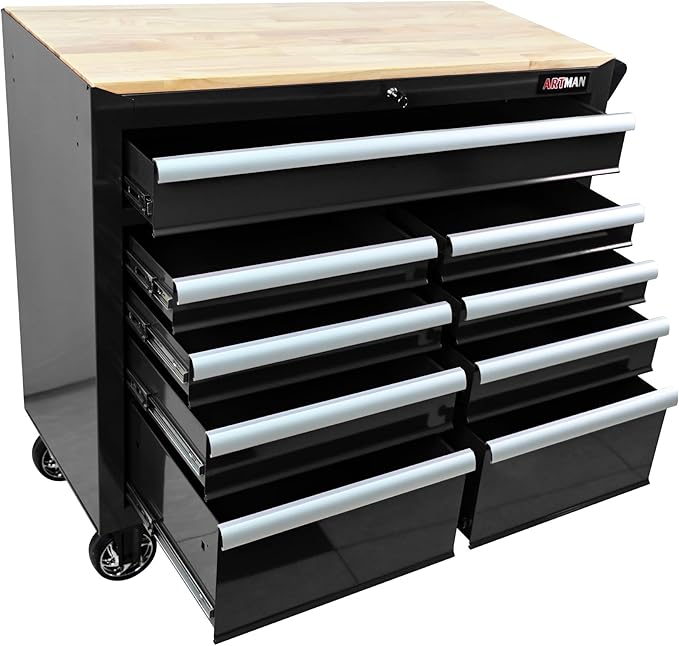
A Husky rolling tool box is a good choice if you want strong tool storage that can move around your garage, workshop, driveway, or job area. For most homeowners, a 46-inch or 52-inch Husky rolling cabinet offers the best balance of storage, mobility, and price. For mechanics or heavy tool collections, a Heavy Duty or Professional Duty Husky rolling tool chest is usually the better option.
A rolling tool box is different from a fixed garage cabinet because it gives you flexible access to your tools. You can move it closer to your car, workbench, lawn equipment, or repair project instead of walking back and forth across the garage.
What Is a Husky Rolling Tool Box?
A Husky rolling tool box is a mobile tool storage cabinet designed with drawers, caster wheels, a locking system, and a steel frame. Some models are simple rolling cabinets, while others are larger mobile workbenches with wood tops, power strips, deep drawers, and heavy-duty casters.
Most Husky rolling tool boxes are used for:
- Garage tool storage
- Automotive repair tools
- Home improvement tools
- DIY project organization
- Mechanic tools
- Workshop storage
- Power tool storage
- Socket and wrench organization
- Mobile workbench setups
The biggest benefit is mobility. Instead of keeping your tools in one fixed location, you can roll the cabinet where you need it.
Who Should Buy a Husky Rolling Tool Box?
A Husky rolling tool box is best for people who want a mix of storage, strength, and mobility.
It is a good fit for:
- Homeowners who want a cleaner garage
- DIY users with growing tool collections
- Mechanics who need organized socket and wrench storage
- Woodworkers who want a movable work surface
- Contractors who need heavy-duty garage storage
- Car owners who work on vehicles at home
- Small workshop owners who need flexible storage
It may not be the best choice if you only have a few basic tools. In that case, a small portable tool box or wall-mounted storage system may be enough.
Best Husky Rolling Tool Box Sizes
Choosing the right size is one of the most important steps. A rolling tool box that is too small will become crowded quickly. A model that is too large may take up too much garage space.
| Size | Best For | Main Advantage | Possible Drawback |
|---|---|---|---|
| 22-inch rolling system | Portable tools and jobsite use | Easy to move and carry | Limited drawer storage |
| 26–27 inch rolling cabinet | Small garages and basic tools | Compact and affordable | Less room for power tools |
| 46-inch mobile workbench | Homeowners and DIY users | Good balance of storage and space | May be limited for mechanics |
| 52-inch mobile workbench | Most garages and home mechanics | More drawers and work surface | Needs more wall space |
| 56–62 inch heavy-duty box | Serious DIY and mechanic work | Better storage and strength | Heavier and harder to move |
| 72-inch workstation | Large garages and pro shops | Maximum storage and workspace | Requires a large garage wall |
For most garage owners, the best starting point is a 46-inch or 52-inch Husky rolling tool box. These sizes usually provide enough drawer space without overwhelming the garage.
Husky Rolling Tool Box vs Husky Mobile Workbench
Many people use the terms “rolling tool box” and “mobile workbench” in the same way, but they are slightly different.
A Husky rolling tool box usually refers to a tool cabinet on wheels. It focuses mainly on drawer storage and mobility.
A Husky mobile workbench usually includes a wider top surface, often made from wood or another work-friendly material. It is designed for both storage and light work.
Choose a rolling tool box if your main goal is tool organization.
Choose a mobile workbench if you want both tool storage and a surface for small projects, assembly work, repairs, or tool layout.
Standard Duty vs Heavy Duty vs Professional Duty Husky Rolling Tool Boxes
Husky rolling tool boxes are often available in different strength levels. The main categories are Standard Duty, Heavy Duty, and Professional Duty.
Standard Duty Husky Rolling Tool Boxes
Standard Duty models are usually best for homeowners, light DIY work, household tools, and small garages. They are more affordable and often lighter than Heavy Duty models.
Best for:
- Basic hand tools
- Home repair tools
- Light automotive tools
- Garage organization
- Budget-friendly storage
A Standard Duty model is a smart choice if you do not store extremely heavy sockets, mechanic tools, or large power tools.
Heavy Duty Husky Rolling Tool Boxes
Heavy Duty models are better for users with larger and heavier tool collections. They usually offer stronger drawer slides, better weight capacity, thicker steel, and a more durable frame.
Best for:
- Home mechanics
- Serious DIY users
- Automotive tools
- Power tools
- Large socket sets
- Daily garage use
A Heavy Duty Husky rolling tool box is often the best long-term choice if you expect your tool collection to grow.
Professional Duty Husky Rolling Tool Boxes
Professional Duty models are designed for users who need maximum strength, drawer capacity, and long-term durability.
Best for:
- Professional mechanics
- Large workshops
- Heavy tools
- Commercial garage use
- Users who open and close drawers many times per day
Professional Duty models usually cost more, but they are better suited for heavy daily use.
Key Features to Check Before Buying
Before choosing a Husky rolling tool box, compare these features carefully.
1. Caster Strength
Caster wheels are one of the most important parts of a rolling tool box. A cabinet can look strong, but if the casters are weak, it will be difficult to move when loaded.
Look for:
- Large caster wheels
- Locking casters
- Smooth rolling movement
- Strong mounting plates
- High weight rating
- Stable movement on concrete floors
Larger casters are better for garage floors because they roll more smoothly over small cracks, dust, and uneven surfaces.
Locking casters are important because they keep the tool box in place while you open drawers or work on the top surface.
2. Drawer Layout
Drawer layout affects how easy it is to organize your tools.
Shallow drawers are best for:
- Sockets
- Ratchets
- Screwdrivers
- Pliers
- Wrenches
- Measuring tools
- Small parts
Deep drawers are best for:
- Drills
- Grinders
- Batteries
- Sanders
- Impact wrenches
- Hammers
- Power tools
- Large accessories
A good rolling tool box should include a mix of shallow, medium, and deep drawers. This gives you more flexibility.
3. Drawer Slide Capacity
Drawer slide capacity tells you how much weight each drawer can handle. This is especially important if you store sockets, impact tools, metal tools, or mechanic equipment.
For light tools, standard drawer slides may be enough. For heavier tools, look for stronger ball-bearing slides or double slides on deep drawers.
A drawer with weak slides may sag, stick, or become difficult to close over time.
4. Steel Gauge
Steel gauge affects the strength of the tool box. A lower gauge number usually means thicker steel.
For example, a heavier-duty box with thicker steel will usually feel more solid than a thin, lightweight cabinet.
Thicker steel is helpful if you plan to store:
- Heavy socket sets
- Pullers
- Pry bars
- Impact tools
- Large wrenches
- Power tools
- Automotive repair tools
For light household use, standard steel construction may be enough. For mechanic work, thicker steel is usually worth the upgrade.
5. Locking System
A good Husky rolling tool box should include a lock system to help protect your tools.
This is useful if:
- You share a garage
- You work in a shop
- You store expensive tools
- You keep tools near an open garage door
- You want to prevent children from opening drawers
Before buying, check whether the box uses a keyed lock, how many drawers lock, and whether replacement keys are available.
6. Work Surface
Some Husky rolling tool boxes include a solid wood top or workbench-style surface.
This is useful for:
- Small repairs
- Tool layout
- Assembly work
- Measuring parts
- Cleaning tools
- Holding chargers or small equipment
If you need a working surface, choose a Husky mobile workbench instead of a simple rolling cabinet.
7. Power Strip and USB Ports
Some Husky mobile workbenches include a built-in power strip or USB charging area.
This can be helpful for charging:
- Drill batteries
- Phone
- Work light
- Battery chargers
- Small electronics
- Diagnostic tools
A built-in power strip is not required, but it can make your garage setup more convenient.
8. Total Weight Capacity
Total weight capacity tells you how much weight the full cabinet can support. This includes tools, drawers, and anything placed on the top surface.
If you own mostly light household tools, you may not need the highest capacity model.
If you own heavy mechanic tools, choose a Heavy Duty or Professional Duty model with a higher total capacity.
Always place heavier tools in the bottom drawers to keep the box stable.
Best Husky Rolling Tool Box by Use Case
Best for Small Garages
A 26-inch or 27-inch Husky rolling cabinet is best for small garages. It is compact, easier to move, and suitable for basic home tools.
Best for:
- One-car garages
- Apartment garages
- Light DIY tools
- Household repairs
- Small tool collections
Best for Most Homeowners
A 46-inch Husky mobile workbench is a strong choice for most homeowners. It gives you more drawer space than a small cabinet while still fitting in many garages.
Best for:
- Home improvement tools
- DIY projects
- Lawn equipment tools
- Small power tools
- General garage organization
Best for Home Mechanics
A 52-inch Husky rolling tool box or mobile workbench is usually the best option for home mechanics. It provides better drawer space for sockets, ratchets, wrenches, power tools, and automotive equipment.
Best for:
- Socket sets
- Wrench sets
- Car repair tools
- Impact tools
- Battery chargers
- Garage workstations
Best for Heavy Tool Collections
A 56-inch, 62-inch, or 72-inch Husky Heavy Duty or Professional Duty tool box is better for large tool collections.
Best for:
- Mechanics
- Contractors
- Serious DIY users
- Large garages
- Heavy tools
- Daily workshop use
Husky Rolling Tool Box Pros and Cons
Pros
- Good value for garage storage
- Available in many sizes
- Rolling design improves mobility
- Many models include locking drawers
- Good options for homeowners and mechanics
- Mobile workbench models add extra workspace
- Heavy Duty and Professional Duty options are available
- Useful drawer layouts for hand tools and power tools
Cons
- Larger models need more garage space
- Heavy loaded cabinets can be difficult to move
- Standard Duty models may not be enough for heavy tools
- Replacement parts may depend on model number
- Some models may require assembly
- Large boxes may be difficult to unload without help
How to Choose the Right Husky Rolling Tool Box
Use this simple buying process.
Step 1: Measure Your Garage Space
Measure the wall where you want to place the tool box. Also check:
- Vehicle clearance
- Garage door space
- Walking space
- Door swing
- Workbench area
- Power outlet location
Do not buy a 72-inch rolling tool box unless you have enough open wall space.
Step 2: Count Your Tools
Think about your current tools and future tools.
If your tool collection is still growing, buy slightly larger than you need today.
Step 3: Check Tool Weight
Heavy tools need stronger drawers and better slides.
Heavy tools include:
- Socket sets
- Impact wrenches
- Hammers
- Pullers
- Pry bars
- Large wrenches
- Power tools
If you own many heavy tools, avoid very light-duty cabinets.
Step 4: Decide Between Cabinet and Workbench
Choose a rolling cabinet if you mainly need storage.
Choose a mobile workbench if you also want a work surface.
Step 5: Compare Drawer Slides and Casters
Drawer slides and casters affect long-term usability. Smooth slides and strong wheels make the box easier to use every day.
How to Organize a Husky Rolling Tool Box
A good organization system makes your rolling tool box easier to use.
Use this layout:
Top Drawers
Store frequently used tools:
- Ratchets
- Sockets
- Screwdrivers
- Pliers
- Allen keys
- Measuring tape
- Utility knife
Middle Drawers
Store medium-use tools:
- Wrenches
- Electrical tools
- Specialty tools
- Drill bits
- Driver bits
- Small accessories
Bottom Drawers
Store heavy tools:
- Drills
- Grinders
- Batteries
- Hammers
- Impact tools
- Large socket sets
- Power tool cases
This layout keeps the center of gravity low and helps prevent tipping.
Safety Tips for Moving a Loaded Rolling Tool Box
A loaded Husky rolling tool box can be very heavy. Move it carefully.
Follow these safety tips:
- Close and lock all drawers before moving
- Push slowly
- Do not pull from the side
- Avoid steep slopes
- Keep heavy tools in bottom drawers
- Do not move the box with drawers open
- Use help when moving large cabinets
- Lock the casters after positioning the box
Never roll a fully loaded tool box quickly across uneven floors.
Common Mistakes to Avoid
Avoid these mistakes when buying or using a Husky rolling tool box:
- Buying a box that is too small
- Ignoring drawer slide capacity
- Not measuring garage space first
- Overloading top drawers
- Moving the box with drawers open
- Choosing Standard Duty for very heavy tools
- Forgetting to check caster quality
- Not saving the model number
- Ignoring replacement key availability
- Placing the tool box on an uneven floor
Husky Rolling Tool Box vs Portable Rolling Tool Box
A Husky rolling tool cabinet is best for garage and workshop storage. It usually has multiple drawers, caster wheels, and a larger steel frame.
A Husky portable rolling tool box is better for jobsite use or moving tools from one place to another. It is smaller, easier to transport, and usually has less drawer-style organization.
Choose a rolling cabinet if your tools mostly stay in the garage.
Choose a portable rolling system if you regularly move tools between job sites, vehicles, or outdoor projects.
Final Recommendation
For most homeowners, the best Husky rolling tool box is a 46-inch or 52-inch mobile workbench. These sizes provide a strong balance of storage, work surface, mobility, and price.
For small garages, choose a 26-inch or 27-inch rolling cabinet.
For home mechanics, choose a 52-inch Heavy Duty model.
For professional use or very heavy tool collections, choose a 56-inch, 62-inch, or 72-inch Heavy Duty or Professional Duty Husky tool box.
The right choice depends on your garage space, tool weight, drawer needs, and how often you use your tools.
FAQs
Are Husky rolling tool boxes good?
Yes, Husky rolling tool boxes are a good option for homeowners, DIY users, and mechanics who want strong garage storage at a reasonable price. They are available in many sizes, including compact rolling cabinets, mobile workbenches, and heavy-duty tool chests.
What size Husky rolling tool box should I buy?
For small garages, choose a 26-inch or 27-inch rolling cabinet. For most homeowners, a 46-inch or 52-inch mobile workbench is a better choice. For mechanics or large tool collections, consider a 56-inch, 62-inch, or 72-inch model.
Is a Husky mobile workbench better than a rolling cabinet?
A Husky mobile workbench is better if you need both storage and a work surface. A rolling cabinet is better if you mainly need drawer storage and mobility.
Can you move a Husky tool box when it is fully loaded?
You can move some Husky rolling tool boxes when loaded, but you should do it carefully. Close all drawers, lock them if possible, push slowly, and avoid uneven floors. Very large loaded cabinets may require help.
Do Husky rolling tool boxes have locks?
Many Husky rolling tool boxes include keyed locking systems. The lock setup can vary by model, so always check the product details before buying.
What tools should go in the bottom drawers?
Heavy tools should go in the bottom drawers. This includes drills, grinders, impact tools, batteries, hammers, pry bars, and large socket sets. Keeping heavy tools low improves stability.
Are Husky rolling tool boxes good for mechanics?
Yes, Husky rolling tool boxes can be a good choice for home mechanics and some professional users. Mechanics should look for Heavy Duty or Professional Duty models with stronger drawer slides, better weight capacity, and durable casters.
What is the difference between Standard Duty and Heavy Duty Husky tool boxes?
Standard Duty Husky tool boxes are better for light garage storage and household tools. Heavy Duty models are stronger and better for heavier tools, larger tool collections, and frequent use.
Do I need a 52-inch or 72-inch Husky tool box?
A 52-inch Husky tool box is enough for most home mechanics and garage users. A 72-inch Husky tool box is better for large garages, professional shops, or users with many heavy tools.
Where should I place a Husky rolling tool box in my garage?
Place it along a flat garage wall where it does not block your vehicle, doors, outlets, or walking space. If it has a built-in power strip, place it near an outlet.