Husky Rolling Tool Box
Husky Rolling Tool Box – Built to Move, Built to Last
A complete breakdown of the Husky rolling tool box: what separates a rolling chest from a rolling cabinet, how steel gauge and drawer slides change what a box can carry, what caster ratings actually mean on a loaded frame, and how to size, load, assemble and maintain one so it still rolls straight a decade from now.
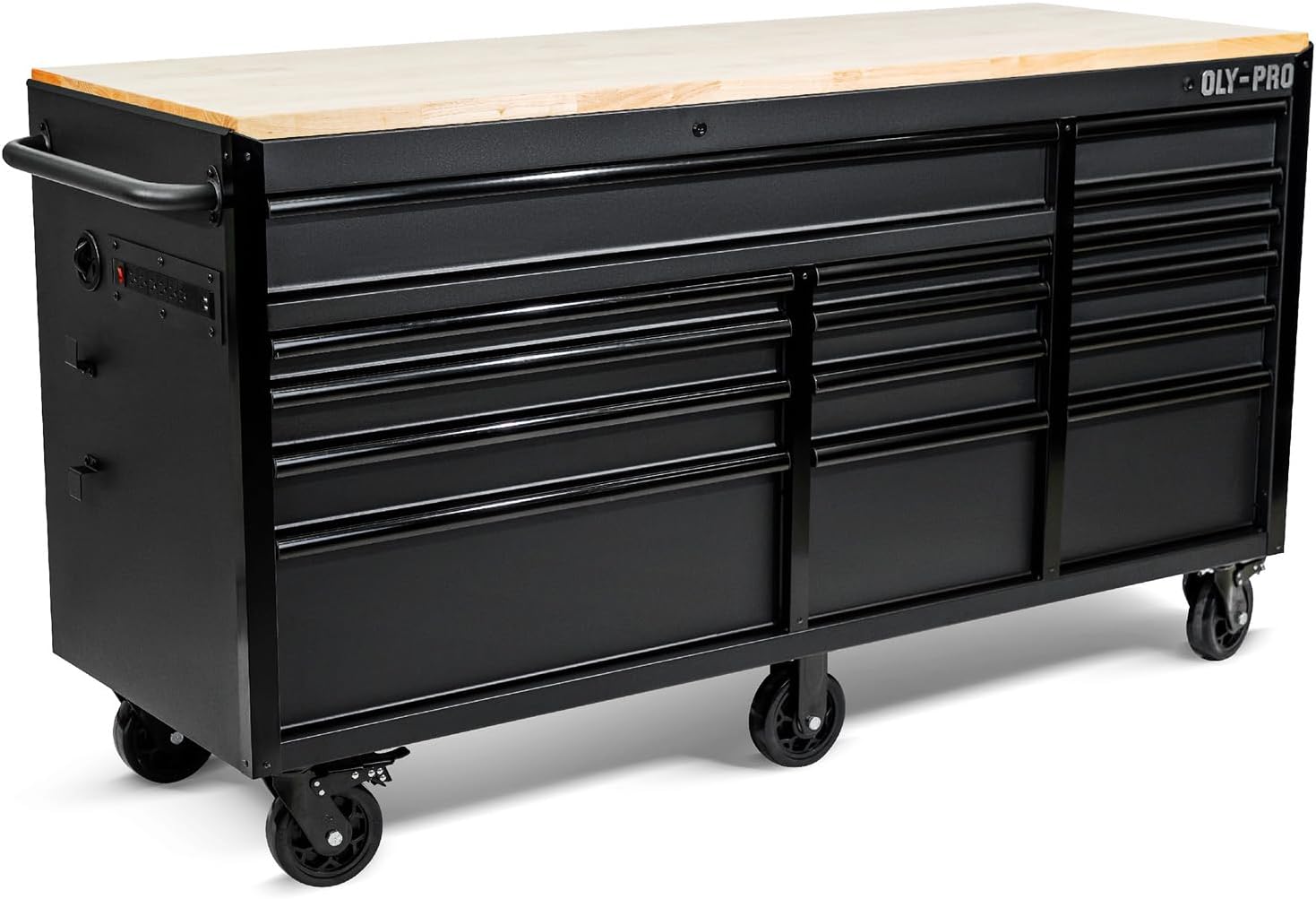 26" – 72" Range
What Is a Husky Rolling Tool Box?
A Husky rolling tool box is a steel drawer cabinet mounted on casters, designed so the whole loaded unit can be pushed to the work instead of the tools being carried back and forth. It is the ground-level half of the tool storage system — the piece that holds the weight, absorbs the load, and moves.
The distinction matters because "tool box" gets used for three very different things. A hand-carry box holds a handful of tools. A top chest sits on a bench or on top of a cabinet and has no wheels of its own. A rolling tool box is the floor-standing unit with its own wheels and its own load rating — the only one of the three that changes how you work rather than just where tools live.
Husky is a house brand sold through The Home Depot, and the rolling line spans from a compact 26-inch chest that fits beside a workbench to a 72-inch Pro Duty workstation with 20 drawers. All of it shares the same engineering language: rolled steel panels, ball-bearing slides, single-key internal locking, and caster sets rated well above what most users will ever load.
- Floor-standing cabinet with its own caster set and load rating
- Ball-bearing drawer slides rated 50–220 lb depending on tier
- 21-gauge steel on standard models, 19-gauge on heavy-duty
- Internal single-key lock that secures every drawer at once
- Wood or steel work surface on workbench-format models
The Rolling Formats
"Rolling tool box" covers four distinct builds in the Husky range. They differ in height, top surface, and what they are meant to do — picking the wrong format is the most common and most expensive sizing mistake.
Rolling Chest
Compact, waist-height, typically 4–5 drawers in a 26–27 inch width. Steel top, no work surface intended. Built for small garages, basements and apartments where floor space is the binding constraint. The lightest unit to move and the easiest to fit through a standard doorway.
Rolling Cabinet
The classic bottom box — deeper drawers, higher capacity, designed to sit under a matching top chest to form a full stack. Steel top, taller drawer count, and caster sets sized for the combined weight of both units once the top chest is seated on it.
Mobile Workbench
A rolling cabinet with a solid wood top, sized as a working surface rather than a lid. Strong enough to mount a vise or bench grinder, refinishable when it gets gouged, and tall enough to work at standing height. The most popular format for home shops that build as well as repair.
Mobile Work Center
The largest builds — 62 to 72 inches wide, 14 to 20 drawers, six casters, and on some models an adjustable-height top. These are workstations rather than storage: full tool loadouts, integrated power management, and modular side lockers or hutches that expand the footprint.
Husky Rolling Tool Box Sizes
Width is the number everyone quotes, but depth and drawer rating decide whether a box actually fits your space and your tools. Measure the depth against your garage walkway before the width against your wall.
| Width | Format | Drawers | Steel | Slide Rating | Casters | Best Suited To |
|---|---|---|---|---|---|---|
| 26" | Rolling chest | 4–5 | 21-gauge | 50 lb | 4 (2 lock) | Small garages, first tool box, apartment workshops |
| 46" | Mobile workbench | 9 | 21-gauge | 50–100 lb | 4 (2 lock) | Home shops that want a work surface without the full footprint |
| 52" | Mobile workbench | 9 | 21-gauge | 50–100 lb | 4 (2 lock) | The all-round garage size — storage plus real bench space |
| 56" | Heavy-duty chest | 10–12 | 19-gauge | 200 lb | 4–6 | Daily use with dense tool loads and soft-close drawers |
| 62" | Work center | 14 | 19-gauge | 200 lb | 6 swivel | Working shops needing maneuverability under full load |
| 72" | Pro Duty work center | 20 | 19-gauge | 220 lb | 6 heavy-duty | Full professional loadouts and modular workstation builds |
How a Rolling Tool Box Is Built
Six components carry the entire load path, from the tools in the drawer down to the floor. Every meaningful difference between a standard and a heavy-duty Husky rolling tool box shows up in one of these six.
Steel Gauge
Gauge runs backwards — a lower number means thicker steel. Standard models use 21-gauge rolled steel; heavy-duty models step to 19-gauge. That difference shows up as chassis rigidity: a thicker frame resists racking when the box is pushed loaded, which is what keeps drawers aligned over years of use.
Drawer Construction
Single-wall drawers are one folded sheet. Double-walled drawers on heavy-duty models add an inner skin and rolled top edges, which stiffens the box section so the drawer face does not bow outward under a full socket set. Rolled edges also take the punishment when tools get dropped in.
Ball-Bearing Slides
Slides carry the drawer weight and set the real capacity limit. Ratings run from 50 lb on compact chests to 220 lb on Pro Duty, with bottom drawers often doubled up for higher loads. Detent retention holds the drawer shut so it will not drift open when the box is on a slope or in motion.
Casters
The defining part of a rolling tool box. Caster diameter, tread material and bearing type determine whether a loaded cabinet glides or fights you. Larger wheels bridge cracks and expansion joints; smaller ones snag. Locking casters take the box out of play once it is positioned.
Locking System
An internal single-key lock drives a vertical bar that captures every drawer at once, rather than a separate catch per drawer. Because the mechanism sits inside the shell, there is no exposed hasp to pry. Keys are model-coded, so a spare should be cut and stored away from the box itself.
Top Surface & Power
Workbench formats use a solid wood top that can be sanded and re-oiled; cabinet formats use a steel lid meant to carry a top chest. Larger models integrate a power strip with outlets and USB ports along the back or sides so battery chargers live on the box instead of trailing across the floor.
Understanding Caster Ratings
A caster rating is the single most misread spec on a rolling tool box. Here is what each part of it actually describes, and how the numbers behave once the drawers are full.
Set Rating vs. Per-Wheel Rating
A quoted figure such as 2,500 lb is the combined capacity of the full caster set, not one wheel. Divide by the number of wheels to get the per-wheel figure, then treat that as the honest number — on uneven floors, load rarely sits evenly across all four or six.
Swivel vs. Fixed
Fixed casters track straight and make a box easy to push in a line. Swivel casters turn on a vertical axis and let the cabinet be spun in place. Larger Husky work centers use six swivel casters with locks at the ends, which trades a little straight-line stability for far better handling in tight bays.
Wheel Diameter and Tread
Diameter decides what the box will roll over. A 5-inch wheel clears an expansion joint or a dropped extension cord that stops a 3-inch wheel dead. Softer tread compounds roll quieter and grip better on sealed concrete; harder compounds roll with less effort but transmit more shock into the frame.
Locking Behaviour
Most locks are wheel brakes — they stop the wheel from rotating but not the swivel head from turning, so a locked box can still shift slightly under a hard push. Lock the casters diagonally opposite each other for the most stable footprint, and lock all of them before working on top of the box.
Floor Surface
Sealed or epoxy-coated concrete is the ideal surface. Bare porous concrete sheds grit into the bearings, and gravel or expansion cracks are what bend axles over time. On rough floors, larger diameter wheels matter more than a higher load rating.
Loaded Weight Reality
A large rolling cabinet can weigh 400 lb empty. Add a full mechanic's loadout and the moving mass climbs past 700 lb, which is why the caster set is rated so far above the empty weight. Push from the handle with both hands, never drag by a drawer pull.
Choosing the Right Size
Five measurements, taken in this order, will point at exactly one size band. Do them before deciding on drawer count.
Measure the Wall Run, Not the Room
Find the longest uninterrupted stretch of wall with no outlet, door swing or window sill in the way, and subtract 6 inches at each end for clearance. That number is your maximum width — a 52-inch box needs roughly 55 inches with the push handle fitted, and larger models need more.
Check Depth Against the Walkway
Rolling cabinets run 18 to 25 inches deep, and the drawers add another 18 to 22 inches when fully extended. Stand where the box will live and make sure a fully open bottom drawer still leaves a path past the vehicle. This is the measurement most people skip and most regret.
Count Your Actual Tool Load
Group tools by how they store: sockets and drivers in shallow drawers, cordless tools and grinders in deep ones. Two or three shallow drawers plus two deep ones covers a typical homeowner set. A full mechanic's loadout with air tools and multiple socket sets needs 12 drawers minimum.
Decide Whether the Top Is a Lid or a Bench
If you will clamp, cut, assemble or mount a vise, you need a wood-topped workbench format and a standing-height cabinet. If the top exists only to hold a top chest later, a steel-lidded rolling cabinet is the correct choice and costs less for the same drawer capacity.
Plan the Route In
Measure every doorway, gate and turn between the delivery point and the final position. Larger units arrive on a pallet at 400 lb or more and cannot be tipped through a tight corner once assembled. If the route is tight, size down or plan to unpack in the garage itself.
Loading and Weight Balance
How a rolling tool box is loaded decides how long the slides last and how safely it moves. Overloaded and top-heavy boxes are the two failure modes that account for nearly every damaged slide and every tipped cabinet.
- Heavy low, light high. Cordless tools, grinders, breaker bars and impact guns belong in the bottom deep drawers. Sockets, drivers and precision tools go up top.
- Respect the per-drawer rating. A 100 lb slide means 100 lb in that drawer, not 100 lb averaged across the box. A full socket set with a case is heavier than it looks.
- Open one drawer at a time. Multiple extended drawers move the centre of gravity forward, which is exactly how a loaded cabinet tips.
- Spread the load side to side. Concentrating dense tools at one end puts uneven load on two casters and drags the box off a straight line when pushed.
- Use the liners. Non-slip liners stop tools sliding to the drawer front on every open and close, which is what wears detents and dents drawer faces.
- Leave the top clear before moving. Anything loose on the work surface becomes a projectile the moment a caster hits a joint.
Assembly and Long-Term Care
Most rolling tool boxes arrive with the shell built and only the casters to fit. The first hour and the yearly hour after that are what separate a box that still rolls true in year ten from one that binds in year three.
Fitting the Casters
Tip the empty shell onto a padded surface or lay it on the packaging, then bolt each caster plate with all fasteners started before any are tightened. Torque them in a cross pattern so the plate seats flat. Fit swivel casters at the corners you will steer from and locking casters at the ends. Budget about fifteen minutes and a second pair of hands for anything over 46 inches.
First Roll and Level Check
Roll the empty box to its position and check it does not rock. A garage floor graded toward the door will make one caster sit proud — reposition rather than shim, because shimming a caster set puts constant load on one wheel. Lock the casters and load the bottom drawers first to plant the centre of gravity.
Wipe Down and Clear the Wheels
Wipe the shell with a damp cloth and a mild detergent — solvents and abrasive pads will cut the powder coat. Pick swarf, zip ties and hair out of the caster wheels and swivel heads, which is the single most common cause of a box that suddenly steers badly.
Slides, Bearings and Fasteners
Pull each drawer fully out and apply a light dry lubricant to the bearing race — never a heavy grease, which collects grit and turns into a lapping compound. Put a drop of oil in each caster swivel and axle. Re-check every caster fastener with a wrench; they work loose from vibration over a year of rolling.
Wood Top and Rust Watch
Sand a wood top lightly with fine paper and re-oil to keep it sealed against solvents and coolant. Check the underside of the shell and the caster plates for early surface rust, especially in damp or unheated garages, and touch in chips with matching paint before they spread under the coating.
Common Problems and Fixes
Six issues account for most of what goes wrong with a rolling tool box, and all six have a straightforward cause.
Usually a floor that slopes toward the door rather than a fault in the slides. Reposition the box, or turn it so the drawer faces point uphill. If it happens on a level floor, the detent is worn or the drawer is loaded past its rating.
Either grit in the bearing race or a chassis that has racked from being dragged by one corner. Clean and dry-lubricate the slides first. If binding persists on one side only, loosen the caster fasteners, let the frame settle on a flat surface, then re-torque.
Debris wrapped in a swivel head, or load concentrated at one end. Clear the wheels, then redistribute dense tools evenly across the drawer width. A flat spot worn into one tread will also pull the box off line.
Loose mounting fasteners, almost always. Vibration from rolling backs them out over months. Empty the bottom drawers, tip the box safely, and re-torque every plate in a cross pattern. Replace any caster with visible axle play.
The internal lock bar has slipped out of engagement, generally after the box has been moved with a drawer part-open. Open all drawers, close them fully in sequence from the bottom, then cycle the key. If it still fails, the bar linkage needs re-seating from inside the shell.
Damp storage and chipped powder coat. Sand the spot back to bright metal, prime, and touch in with matching paint. In an unheated garage, a small dehumidifier does more for the finish than any coating, and it protects the tools inside too.
What Owners Are Saying
Notes from people running a Husky rolling tool box day in, day out.
I needed to replace a worn out tool chest and searched for the right one for a month. Every chest I looked at seemed to be cheaply made and overpriced. Then I saw this Olympia Tool chest and really liked the design and price. I was very impressed when I received it. The drawers glide smoothly and the bottom drawer has double rails that for the extra support. It appears to be a very robust tool chest, for the price. I couldn’t be more pleased with this tool chest. It even has chrome wheels!!
Very spacious and lockable. It's heavy duty. I would like to suggest adding removable wheels for this box so it can be used as a separate portable tool box. Edited : found two dents in the bottom area and two small corrosion inside. Nothing serious. Still it's in good shape. But the Manufacturer should consider more about the quality of the final product.
Room for all my tools! Was packed well and survived with very minor tweaking required after unpacking. Finish is very nice, drawer slides run smoothly. CAUTION! the lid is not locked and has those nice gas shocks to keep it open when using. if you're not careful (like me) you will lift the toolbox onto your workbench, it will open forcefully and smack you in the nose. made my eyes water.
Very easy to put together heavy duty metal looks great in the garage and by far it's the best tool cabinet I have bought so far very heavy duty. I would definitely recommend buying this tool cabinet I bought other ones before and they were really flimsy, you'll be very happy when you buy this one after all you get what you pay for.
I give it a 5 for the money bc I got 30% off the bottom half. But it’s a great tool box comes with drawer liners and wider and deeper than other's I had looked at and It’s sturdy. I have the wheels on wood bc my garage floor isn’t completely level. I did buy the top piece separate.
Having ordered a smaller version of this box, I was left unimpressed by what that box offered. That box arrived with runs in the paint and mis-aligned gaps. I overlooked those issues because it was an inexpensive box. This chest is totally different. It is larger and more expensive. The initial unboxing and subsequent examination left me really impressed. The blue paint had zero runs and was comparable to more expensive chests I’ve had. Also, every single gap was perfect. The drawers slide nicely and the soft-close is nice as well. Drawer liners were included, which is very convenient and keeps you from having to buy those separately. The only issue I had turned out to be nothing. After unboxing, the two bottom drawers would not open. I even took the above drawers out to try and make them open by force. No luck. Then I just gave each of the drawers a quick forceful snatch and they popped open. Function for those two drawers was fine after that. Not sure why they wouldn’t open to begin with. Final thoughts: This box is great…well made, good gaps, good paint and the size is nice. I would absolutely buy another one of these. I’m very satisfied.
Rolling Tool Box FAQ
What is the difference between a rolling tool box and a tool chest?
A rolling tool box is the floor-standing unit with its own casters and its own load rating. A tool chest has no wheels — it is designed to sit on a bench or on top of a rolling cabinet, and it holds shallower drawers for hand tools. Stacked together they form a complete storage combination, with the rolling cabinet carrying the weight of both.
How much weight can a Husky rolling tool box hold?
There are two separate limits. Each drawer is limited by its slide rating, which runs from 50 lb on compact chests to 220 lb on Pro Duty models, with bottom drawers sometimes doubled for higher capacity. The whole cabinet is limited by the caster set, which on heavy-duty models is rated up to 2,500 lb combined. The drawer rating is the one you will hit first.
Can I move a rolling tool box when it is fully loaded?
Yes — that is what the caster rating exists for. Unlock every caster first, clear the top surface, close all drawers, and push from the handle with both hands rather than pulling on a drawer pull. Take expansion joints and thresholds slowly and at a straight angle. Once positioned, lock the casters before working on or around the box.
What does 19-gauge steel mean and does it matter?
Gauge measures sheet thickness on an inverted scale — 19-gauge is thicker than 21-gauge. In practice the heavier gauge gives the frame more resistance to racking and denting, which keeps drawer openings square and slides aligned under heavy loads. For occasional homeowner use the difference is modest; for daily professional use it is the main reason to step up to the heavy-duty line.
Do rolling tool boxes come assembled?
The shell and drawers arrive built. On most models only the casters and the push handle need fitting, which takes about fifteen minutes with a wrench. The largest work centers can weigh over 400 lb empty and ship on a pallet, so plan for pallet handling and a second person before delivery day.
How do I stop the drawers from sliding open on a sloped floor?
Most garage floors are graded toward the door, so the simplest fix is to turn the box so the drawer faces point uphill, or move it to a flatter run of floor. Detent retention on the slides is designed to hold drawers shut on a mild grade; if drawers still creep on level ground, the drawer is overloaded or the detent is worn.
What kind of lubricant should go on the drawer slides?
A light dry lubricant, applied sparingly to the bearing race with the drawer fully extended. Avoid heavy greases and general-purpose penetrating sprays — they attract metal filings and shop dust, and the resulting paste wears bearings faster than running the slides dry. Once a year is enough for typical use.
Are the drawer liners and locks included?
Non-slip drawer liners and the internal keyed locking system are standard across the rolling line, with two keys supplied. The lock drives a single internal bar that secures every drawer at once. Cut a spare key early and store it away from the box — replacements are model-coded and take time to source.
How long does a rolling tool box last?
With drawers loaded inside their ratings, casters kept clear, and fasteners re-torqued annually, a steel rolling tool box is a decade-plus item — the wood top and the caster treads are the wear parts, and both are serviceable. The failures that end a box early are overloading a drawer and dragging a loaded cabinet by one corner.
Find Your Rolling Tool Box
From the 26-inch rolling chest to the 72-inch Pro Duty work center — heavy-duty rolled steel, ball-bearing slides and caster sets built to move a full loadout across the shop.
Affiliate Disclosure: This site participates in affiliate advertising programs. When you use a "Shop Now" button on this page and complete a qualifying purchase, we may earn a small commission at no additional cost to you. Pricing and availability are set by the retailer and can change at any time.
© 2026 Husky Tool Boxes · All Rights Reserved